Are Walking Pads Worth It? Honest Pros and Cons (2026)
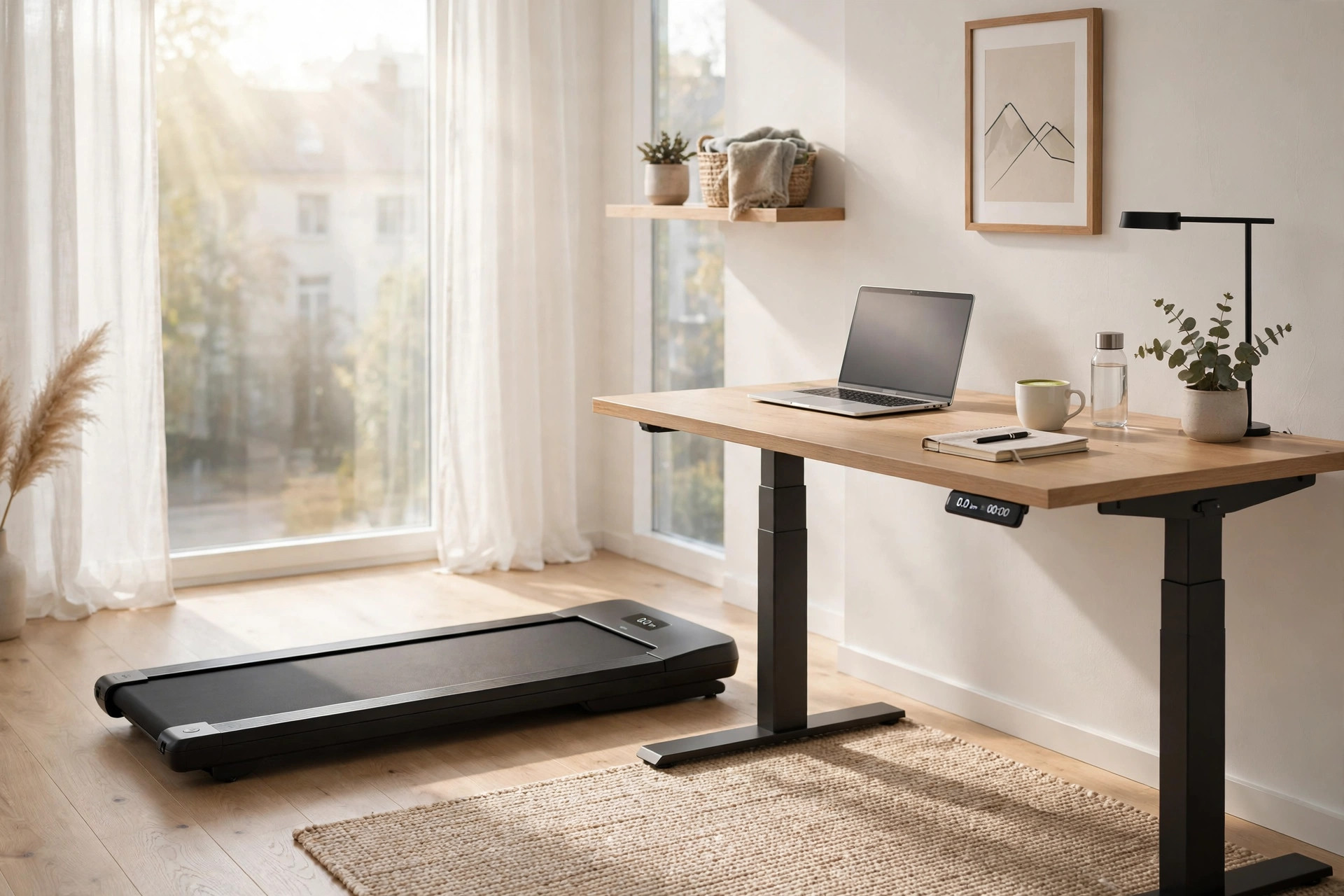
A walking pad costs $150 to $500, once. A gym membership costs $50 to $70 every month. Whether the walking pad is worth it depends on what you need it to do.
The quick verdict
For remote workers with a standing desk, yes. A walking pad turns dead work hours into 8,000 to 10,000 steps a day. It pays for itself in three to six months against a mid-tier gym membership.
For runners, no. A walking pad tops out around 4 mph. It will not train you for anything.
For anyone without a height-adjustable desk, hold off. The pad is useless if your desk cannot reach walking height.
The sections below lay out the full case on both sides so you can decide with clear eyes.
See current walking pad prices
What walking pads do well
1. Steps without scheduling
This is the entire pitch. You walk at 2 mph while answering email. Four hours of that is roughly 8,000 steps banked before lunch, with zero dedicated workout time. People who "have no time to exercise" usually mean they have no free hour. A walking pad does not ask for one.
2. No commute, no weather, no excuses
The gym requires leaving the house. Outdoor walks require decent weather and daylight. A walking pad sits in your home office and works at 6 a.m. or 10 p.m. equally well. Consistency beats intensity for most people. Removing friction is how consistency happens.
3. Compact storage
This is where walking pads beat full treadmills by a wide margin. Folding models go down to about 5 inches thick and slide under a bed or couch. Slim non-folding models lean against a wall. A full treadmill owns a corner of your room permanently. A walking pad disappears after work.
4. Low impact on joints
Walking is about as joint-friendly as cardio gets. Most pads use multi-layer belts with some cushioning built in. For people with knee or ankle concerns who find running punishing, steady walking is a workable daily habit. Check with a professional if you have an existing condition. The wellness disclaimer at the bottom applies.
5. One payment, no subscription
A walking pad costs $150 to $500 once. There is no monthly fee, no annual maintenance charge, no enrollment fee. Gyms layer all three on top of the advertised monthly rate. The cost math section below works this out in detail.
6. Quiet enough for calls
Brushless-motor models run around 45 to 55 dB at walking speed, roughly a quiet conversation. Footfall through the floor is usually louder than the motor itself. A mat underneath solves most of it. Plenty of remote workers take calls while walking without complaints from the other end.
Where they disappoint
1. Limited intensity ceiling
Most walking pads top out at 3.5 to 4 mph. That is brisk walking. It will not build serious cardiovascular fitness the way running or cycling does. If your goal is serious fitness rather than sitting less, a walking pad alone will not get you there. It is a sedentary-reduction tool first and a fitness tool second.
2. Typing degrades above 2 mph
The marketing shows people typing full speed while walking. In practice, most people type comfortably up to about 2 mph. Past that, error rates climb and mouse precision drops. Fine for calls and reading. Less fine for detailed spreadsheet work. Plan your walking tasks accordingly.
3. Cheap models wear out fast
Sub-$200 pads cut corners on motors and belts. Thin belts stretch. Weak motors overheat under heavier users. The weight capacity number is a durability signal. A 220-lb-rated pad carrying a 200-lb walker runs near its limit every day. Budget for at least the mid-range if you plan daily use.
4. Most have no incline
Flat walking burns roughly 150 to 200 calories per hour at a 2 mph desk pace, depending on body weight. Incline would raise that substantially. Most walking pads are flat-only. Incline models exist and cost $100 to $200 more. See our incline walking pad guide if that matters to you.
5. Monotony is real
Walking in place, facing the same wall, for hours. Some people find it meditative. Others last two weeks before the pad becomes an expensive clothes rack. Podcasts and audiobooks help. So does varying speed. Be honest with yourself about which type you are before buying.
6. Your desk has to cooperate
The pad needs a desk that reaches 40 to 48 inches high. Fixed-height desks do not work. Neither do desks with crossbars at knee level. Measure before ordering. This single requirement disqualifies more buyers than any other.
Who should buy one
Remote or hybrid workers with a standing desk are the core audience. If you sit for eight hours and own a height-adjustable desk, a walking pad is close to a default yes.
Small-apartment dwellers fit too. When a full treadmill cannot fit and the gym is a 20-minute drive, the pad fills the gap. Storage is the deciding factor here. Measure your under-bed or under-couch clearance first.
People rebuilding a movement habit after a sedentary stretch do well with walking pads. The bar is low. Step on and walk. No intimidation, no commute, no waiting for equipment.
Who should skip
Runners should skip. Full stop. You need real speed and real incline for training. A walking pad provides neither at running levels. Buy a treadmill or keep the gym membership.
Anyone over the weight capacity should skip, or buy a higher-capacity model. Most pads rate 220 to 265 lbs. Running a motor at its limit shortens its life and voids the point.
People who need external motivation should think twice. A walking pad does not remind you to use it. If you only exercise when a class starts at 6 p.m. sharp, home equipment of any kind tends to gather dust. The 67% unused gym membership statistic exists for a reason. Home equipment has its own version of it.
Anyone without a height-adjustable desk should fix the desk first. The pad without the desk is a paperweight.
Cost comparison
The table below uses illustrative numbers. Gym pricing comes from 2026 US market data. Walking pad and treadmill prices are typical street ranges. Your numbers will differ.
| Walking pad | Gym membership | Full treadmill | |
|---|---|---|---|
| Upfront cost | $150–$500 | $25–$200 enrollment | $500–$2,000+ |
| Monthly cost | $0 | $50–$70 | $0 |
| Annual fees | $0 | $25–$70 | $0 |
| 2-year total | $150–$500 | $1,250–$1,950 | $500–$2,000+ |
| Cost per session (5x/week) | ~$0.30–$1.00 | ~$2.40–$3.75 | ~$1.00–$3.85 |
| Space needed | Disappears after use | None at home | Permanent corner |
| Workout ceiling | Walking only | Full gym | Running + incline |
Cost per session assumes 5 sessions a week for 2 years (520 sessions). Gym math uses $55/month plus $50/year in fees. If you go to the gym twice a week instead of five times, the per-session cost roughly doubles. That is the more realistic number for most members.
The break-even point against a gym is fast. A $300 walking pad costs less than six months of a mid-tier membership. Against a treadmill, the pad wins on price and space, and loses on capability. Pick based on which side of that trade you live on.
Frequently asked questions
Can you lose weight with a walking pad?
Within reason, yes. Three hours at 2 mph burns roughly 400 to 600 calories depending on body weight. Keep your diet unchanged and that is a real daily deficit. Diet matters more than the walking. No device outruns a bad diet.
Are walking pads bad for your knees?
Walking is low-impact and generally knee-friendly. Most pads have cushioned multi-layer belts. Cheap thin belts on hard floors transmit more shock, so use a mat if your floors are hard. If you have existing knee issues, check with a professional first.
How long do walking pads last?
Expect 2 to 5 years of daily use depending on build quality and user weight. Motors are usually the first thing to go, followed by belts. Staying well under the weight capacity and keeping the belt clean extends life. Most come with 1-year warranties. Some extend to 2 or 3 years on the motor.
Do I need a standing desk to use a walking pad?
For under-desk use, yes. The desk must reach 40 to 48 inches. Without that, you can still use the pad as a standalone walker for dedicated sessions, like watching TV. Plenty of owners do exactly that. But the core value proposition assumes a height-adjustable desk.
Walking pad or gym membership: which is better value?
It comes down to attendance. A $55/month gym you visit five times a week costs about $2.50 per session and gives you full equipment access. The same gym visited twice a month costs over $25 per session. Industry data suggests most members land closer to the second number. A walking pad you use daily costs under a dollar per session within the first year. Pick the option you will use.
Prices move. We check regularly but the checkout number may differ. Specs marked * varied by source at publication. See our affiliate disclosure for how we fund the research.